Driving practice3 min read
Give way rules in Australia: STOP signs and T-intersections
At a T-intersection in Australia the road that ends gives way, sign or no sign. STOP means a complete stop; GIVE WAY means slow down.
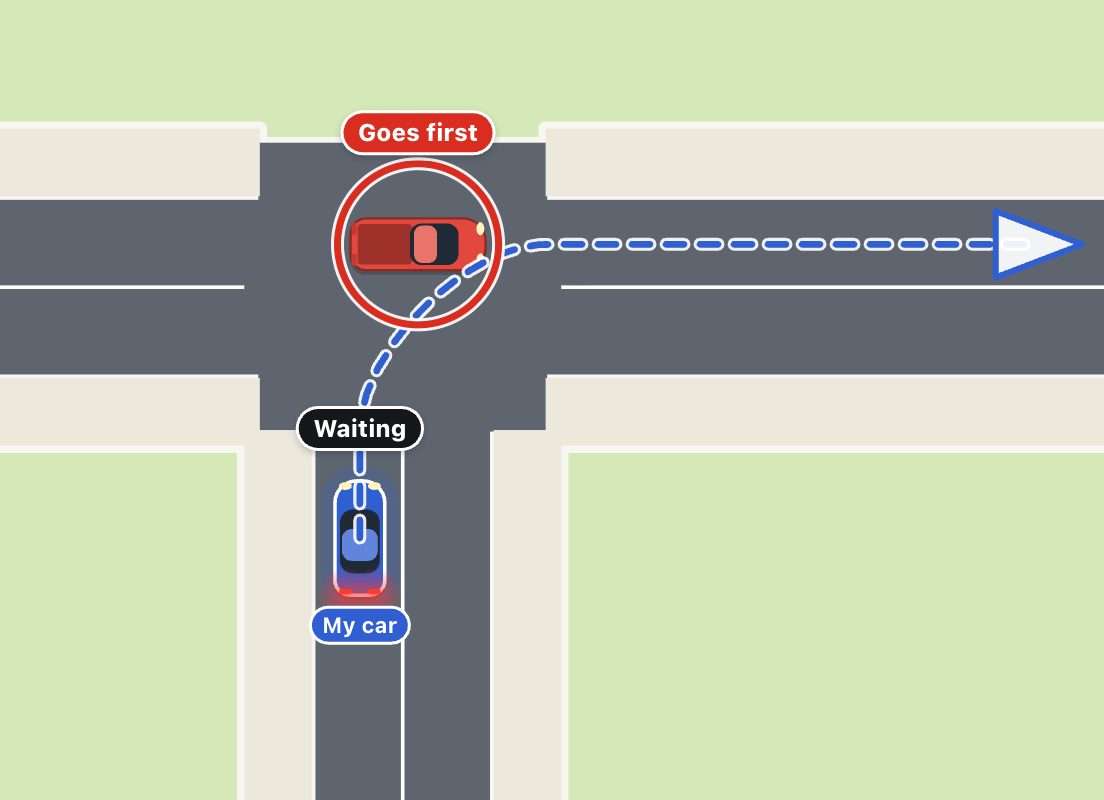
You are driving out of a quiet side street and it simply ends at a bigger road. No lights, no sign, nothing painted on the road. Who goes first? The give way rules in Australia have an answer even when there is no sign at all.
The rule: if your road ends at a T-intersection, you give way to all vehicles on the continuing road, from both directions, unless a sign says otherwise. No sign is needed for that to apply.
In the picture above, the blue car waits at the end of its road while the red car on the continuing road goes first. Because traffic keeps left, the nearest lane brings cars from your right, so look right first, then left.
What does a STOP sign mean in Australia?
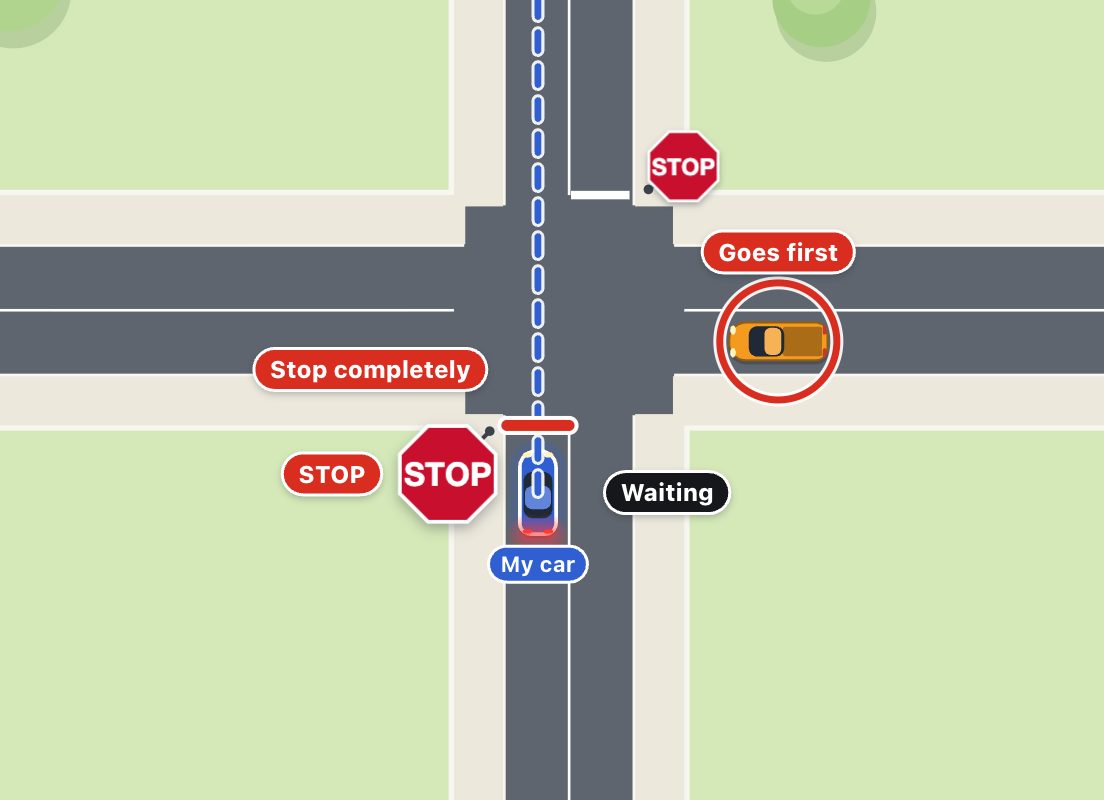
A STOP sign and its stop line (one unbroken line) mean a complete stop, every time, even when you can see that the road is empty. Stop just before the line, as close to it as you can. Then give way to vehicles in, entering or approaching the intersection.
What does a GIVE WAY sign mean?
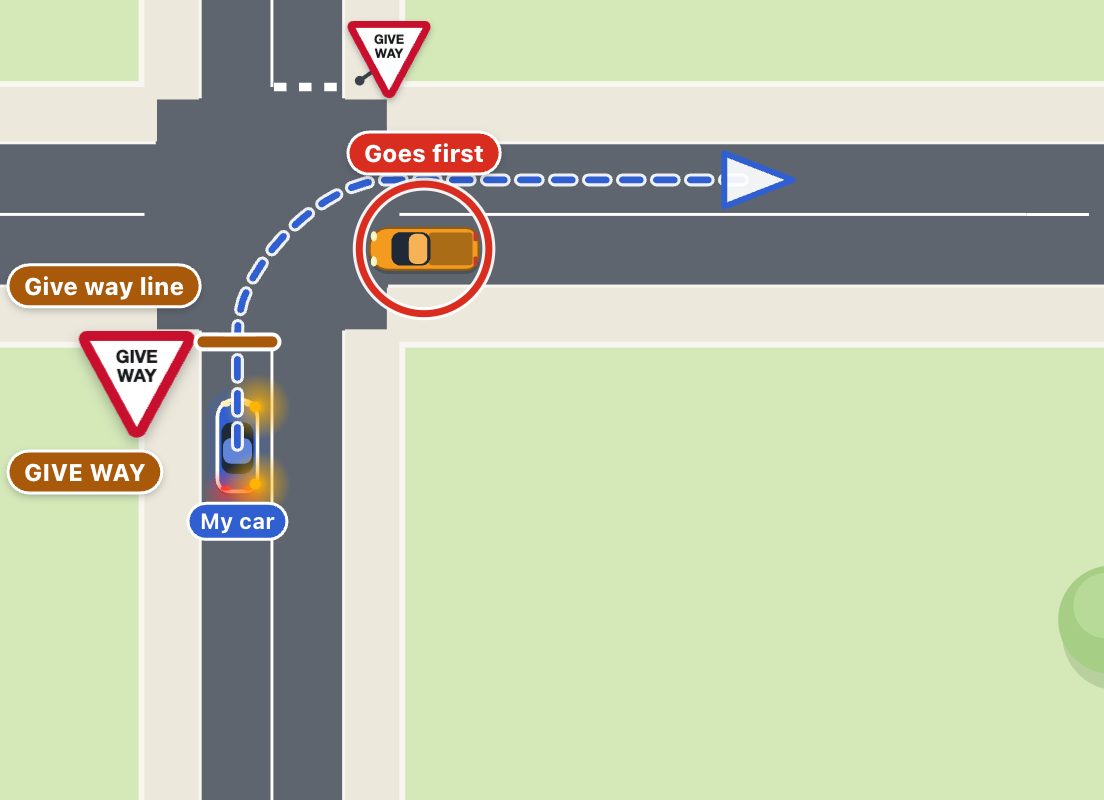
A GIVE WAY sign, or a give way line (one broken line), means slow down and be ready to stop. You give way to the same vehicles as at a STOP sign, but if nobody is coming you may drive on without stopping.
The NSW Government explains both signs on its stop and give way signs page, and the T-intersection rule on its intersections page.
What do you do, step by step?
- Work out early which one you have: a road that ends, STOP, or GIVE WAY.
- Indicate if you are turning.
- At STOP, stop completely. At GIVE WAY or an unsigned T, slow down enough to stop.
- Look right, then left, and wait for vehicles on the other road.
- If you are turning, pedestrians crossing the road you turn into go first.
What does the mistake cost?
The mistake to avoid is the rolling stop: slowing right down at a STOP sign, seeing nobody, and driving on. In NSW (New South Wales, Sydney's state), not stopping at the stop line is A$423, not giving way at a GIVE WAY sign is A$423, and not giving way when you turn out of a road that ends is A$423 (official list as at 1 July 2025; check the current amount).
Is it the same in every state?
These rules are the same across Australia; the fines are not. Queensland's list (1 July 2026), for example, puts failing to stop at a stop line at A$518. Check the state you will drive in.
The entry to a roundabout is a give way line too, and a left turn on red, where a sign allows it, starts with the same complete stop.